My Life as a Cursed Sword: A Review of Artefact

Truly, I really wanted to like Artefact. Several people pointed it out to me as comparable to my current project, Awakened Applewood. Both include conscious objects reckoning with their existence and seeking answers to questions innate to their form that have no correct answer. Yet, while Artefact is definitely a beautiful and well-designed game, it’s not a game for me.
Setting aside the time and space to play was a bit of a challenge. Finally, I had some time on Sunday when not much was going to interfere.
This review is based on an incomplete playthrough; While I did read the book in it’s entirety, I only played about half of the game for reasons I explain later.
The premise of Artefact is that you are a powerful item that an adventurer uses, for good or ill. You are conscious, but not mortal. The person who wields you is called your Keeper.
Many of the details are left to your interpretation. For example, one question on page 29 asks:
A stronghold of great importance was attacked by a dreadful, monstrous horde. How did you help your Keeper drive off the fearsome assailants?
Your exact powers and the influence you have over your Keeper are never set in stone, which I loved.
I love the idea of conscious magical items, so my story seed came to me easily: I was previously a mortal wizard who accidentally transformed himself into an object while searching for immortality. The idea was loosely inspired by the golden skull Kaput from Writing with Andrew, as well as the Umbrastaff in The Adventure Zone: Balance.
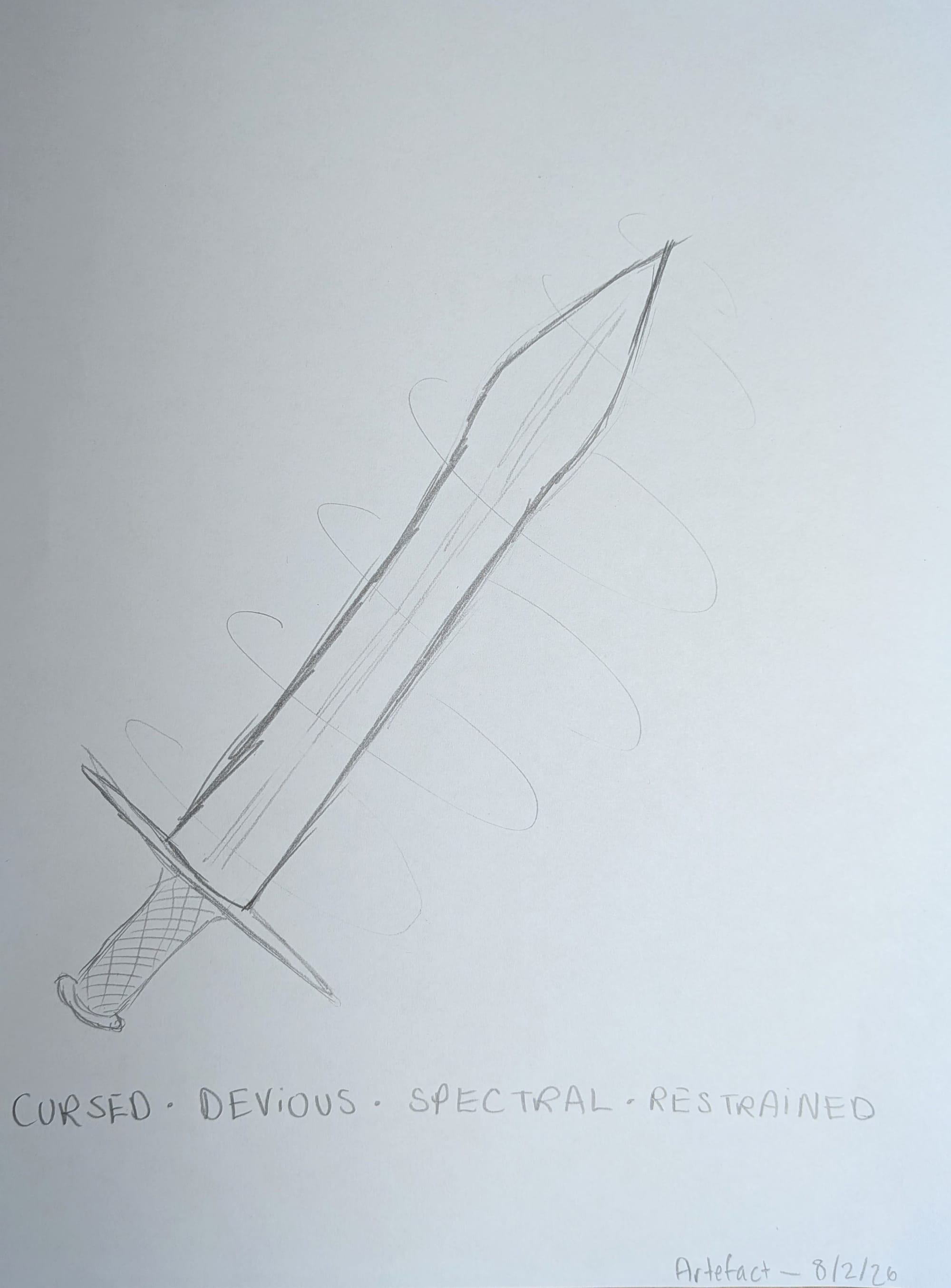
My artefact was a cursed sword with these Traits: Cursed, Devious, and Spectral.
One way I explored the game’s interpretive freedom was through the persistent idea that I had a strong magical aura capable of hurting my Keeper. During one Rest period, I decided that I hated solitude more than I hated my Keepers, so I consciously chose to channel that aura into some other power. To represent this development, I added the Trait “Restrained” to my sheet.
Artefact is clear about the interpretation and invention of Traits, telling the player on page 5:
Don’t worry about a Trait’s precise definition—they mean what you want them to.
The game was really fun, but even the heroic prompts, called Victories & Valour, left me feeling grim.
My first Keeper was a revolutionary leader who used me to overthrow the government, but then died because of my magical aura. A decade passed.
My second Keeper was a rogue who stole me from the palace and used me to defeat a large monster. Afterward, he abandoned me. Another decade passed.
My final Keeper was a warlord who used my historical association with revolution to give herself legitimacy. She then killed the current king with the blade that had once belonged to his long-dead uncle: me.
This was where I stopped. While yes, I made the decision to journal that way, I felt encouraged by the text and art direction to be brutal. But brutality just isn’t in me. I wrote that “…[i]n a bitter duel in the palace courtyard, she challenged the king, a pale man with a scholar’s build. My Keeper’s rival was shocked to see his uncle’s sword thrust through his torso. It was too easy.” Afterwards, I felt upset, primarily with myself.
Even if my character-artefact wanted to change his fate, I couldn’t. A hero picking me up next would just lead to more murder. But if I wanted to stay away from murder altogether, I would have to be in the darkness, because Keepers in this game are following their goals, not yours.
Maybe I’m a little delicate, or maybe I made choices that I later regretted. Although even if I had made different choices, the major themes of this game are loneliness, impermanence, and lack of agency.
There is a strong tension between the abilities and influence that having a Keeper provides and the agency that is removed when you are used for purposes beyond your own desires. One page 4, the game explains:
Through death, bestowal or carelessness, a Keeper relinquishes the item and your stint with them ends.
This prisoner language is used throughout the text to emphasize that you are not following your will, but another. You are just a powerful object. During Rest periods, where you as the player are asked to sit silently for some time, I found myself wondering which was the curse: Being made be a powerful object or being forced to be conscious enough to know your will is being violated.
This is definitely not a cozy game. There are many possibilities not only for violence, but for outright cruelty toward both the player-object and the Keepers. The repeated cycle of being claimed, used, and abandoned eventually became too brutal for me.
Overall, the game is beautifully designed and illustrated, with a cover reminiscent of Shadowdark. The hand-drawn title and new-section headings evokes the idea of someone, or something, leaving behind a scribbled note while dying.
While Artefact is not suited to my tastes, what I learned from it will be very useful moving forward with Awakened Applewood. Its explicit permission to interpret prompts and Traits freely is especially valuable. Its explanation of how the player inhabits the object also demonstrates how a few clear sentences can make an unusual roleplaying perspective accessible to newcomers.
People who enjoy solo journaling games that take a unique perspective to the typical fantasy adventure might enjoy Artefact. Those who enjoy tracing a long history might also enjoy it. If you’re interested in playing this game, check out the itch.io page!
I think ultimately, while the themes and tone weren’t ones that I enjoy, it’s a very fascinating game that I learned a lot from.
For those that are interested in a cozy game where you are a object with questions that need answering, I’m still looking for playtesters for Awakened Applewood through late August, 2026.